Prof. Bofinger and Thomas Haas contributed to the development of the new CEPS publication by Thomadakis, Lannoo and Shamsfakhr. They emphasize the digital euro must provide clear benefits to both consumers and merchants in the EU in order to gain acceptance. Also planners should carefully ensure the minimization of crowding out European private solutions to ensure a functioning European payments market.
moreArchive
News Archive
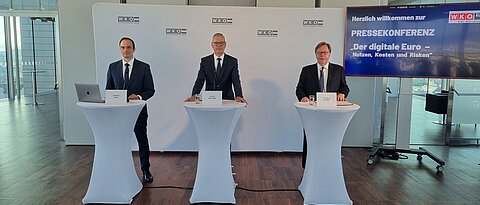
On October 11, a press conference by the Bank and Insurance Division of the Austrian Economic Chambers (WKO) on the Digital Euro took place, featuring Prof. Dr. Peter Bofinger and Thomas Haas. The presented report can be downloaded here for free.
more
Germany is indeed ‘sick’, Peter Bofinger writes—but not for the reason most commentators think.
moreIn the midst of the current debate regarding adjustments in determining the natural rate of interest, Prof. Bofinger and Thomas Haas propose a simpler method. Their approach yields comparable results to existing studies and provides some explanation for the American monetary policy over the last 60 years.
moreAsserting the need for further interest-rate rises, Peter Bofinger writes, is not the same as evidencing them.
moreEurope’s central bank is pushing ahead with the development of electronic currency even as politicians question its purpose.
moreBerlin Excursion of the Dean's List
04/28/2023This year's field trip with Dean's List students took place April 26-28, with visits to EY, the Chancellery, the Bundestag, the Federal Ministry of Labor and Social Affairs, and the Topography of Terror.
moreThe ECB justifies the supposed necessity of a digital euro by its alleged anchor role. In their SUERF Policy Note, Prof. Bofinger and Thomas Haas identify and discuss three potential anchor roles of the digital euro. In doing so, they point out shortcomings in the ECB's argumentation.
moreThe bank was mismanaged but its collapse, Peter Bofinger writes, reveals a system of regulation with as many holes as a Swiss cheese.
moreA Schumpeterian perspective provides new insights for fiscal policy in Europe, Peter Bofinger writes.
moreIn his current column in the Handelsblatt, Prof. Bofinger discusses the remuneration of central bank reserves and whether this constitutes a subsidy for banks.
morePeter Bofinger argues that on the ‘digital euro’ the European Central Bank has dug itself into a hole it would do best to vacate.
moreThe 26. FMM Conference took place under the name "Post Keynesian Economics and Globale Challenges" in Berlin. Prof Bofinger gave a presentation about "Schumpeterian Macroeconomics".
moreNew contribution by Prof Bofinger and Thomas Haas on the Diamond-Dybvig model for bank runs
10/18/2022The paper by Prof. Bofinger and Thomas Haas discusses the 2022 economics nobel price winning paper by Diamond and Dybvig on bank runs.
morePeter Bofinger questions last week’s award of a prestigious economics prize to an orthodox school which could not anticipate the 2008 crash.
more